


Do You Really Need Your Wisdom Teeth Out? Here's How to Tell
The wisdom teeth removal industry seems built on fear. Friends compete over who had the worst experience. Recovery stories sound like medical nightmares. Yet hidden behind all this anxiety is a simple reality: many individuals keep these teeth for life without a single complication.
The challenge lies in determining whether you're someone who needs intervention—or someone who can safely leave well enough alone.
Understanding the Basics
Your wisdom teeth represent your third set of molars. They arrive fashionably late to the dental party, typically making their appearance between ages 17 and 25. The name implies you've reached an age of wisdom and maturity, though anyone who's survived their early twenties knows that's not always accurate.
Here's the crux of the matter: human jaws have shrunk over millennia. Our ancient forebears needed these additional grinding surfaces to process raw, fibrous foods. Modern cooking and food processing have eliminated this need, but our DNA hasn't caught up to this dietary revolution.
When Removal Becomes Necessary
Chronic Discomfort
Pain from wisdom teeth is your body's red flag. It might present as a steady, nagging ache or unpredictable sharp episodes. Some people describe a sensation of pressure building in their jaw, while others feel sudden stabs when chewing.
Never ignore persistent oral pain. It's your system alerting you that professional evaluation is needed.
Impaction Issues
An impacted wisdom tooth is essentially stuck—unable to break through the gum tissue properly. It could be growing at an odd angle, crowding neighboring teeth, or completely buried beneath the surface.
These trapped teeth are troublemakers. They can damage adjacent teeth, create perfect environments for bacterial growth, and lead to infections that require immediate attention.
Recurring Infections
If infections keep returning around your wisdom teeth, extraction is likely your best path forward. These infections, medically termed pericoronitis, develop when food particles and bacteria become trapped under the gum flap covering a partially emerged tooth.
Watch for swelling, persistent bad breath, difficulty opening your mouth, and pain when swallowing.
Crowding Concerns
Wisdom teeth sometimes push hard enough to shift your other teeth out of position. This is especially aggravating if you've invested in orthodontic treatment. Years of careful alignment work can be undone by these late arrivals.
A dentist at Clementi can use imaging technology to determine whether your wisdom teeth are causing crowding now or are likely to do so in the future.
Cyst Development
While uncommon, wisdom teeth can sometimes develop cysts around them. These fluid-filled pockets can gradually destroy jawbone and affect nearby nerves. Tumors are even rarer possibilities.
Regular dental check-ups are essential for catching these serious conditions early.
When You Can Keep Them
Retention is perfectly viable if:
- They've fully erupted and are properly aligned
- You can clean them thoroughly with standard oral hygiene
- They cause no pain or dental problems
- Your jaw has adequate space to accommodate them
Many people function perfectly well with wisdom teeth throughout their entire lives. If yours aren't creating issues, there's no medical reason to remove them.
The Youth Advantage
Younger patients typically recover more quickly from wisdom teeth removal. Their tooth roots aren't fully developed, and their jawbone is less dense. This makes the extraction process simpler and healing faster.
As you move into your 30s and 40s, the roots have grown longer and the bone has become harder. The surgery becomes more complex, and the recovery period extends.
That said, age alone shouldn't dictate your decision. If your wisdom teeth are problem-free at 40, you may never need to address them.
Your Consultation Journey
When you schedule with a dentist near Clementi for a wisdom teeth evaluation, here's what typically happens:
The visit starts with a conversation about your symptoms. Are you experiencing pain? Notice any swelling? Have you seen bleeding from your gums?
Next comes the hands-on examination. Your provider will look closely at your teeth and gums, assessing how your wisdom teeth are positioned.
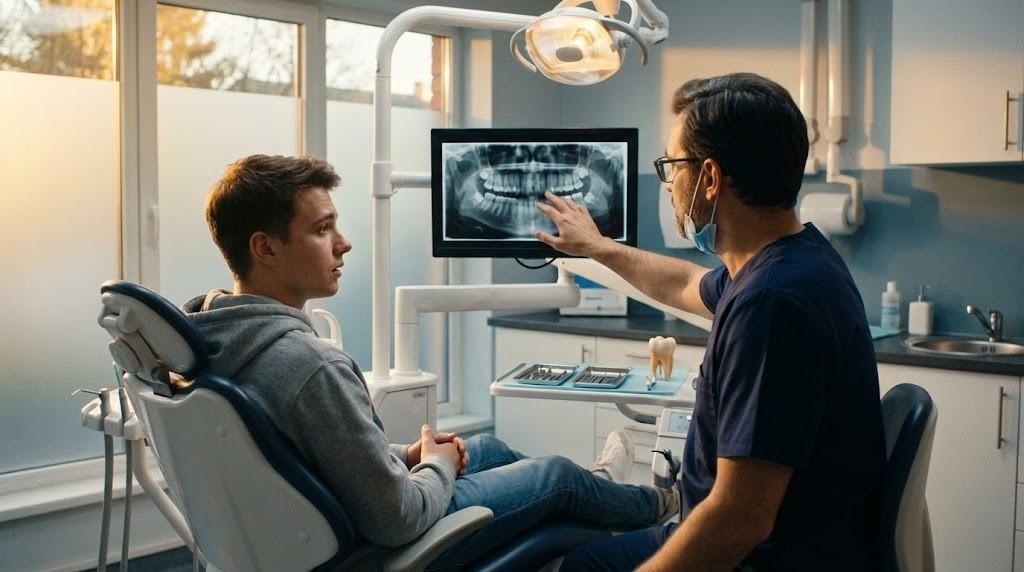
X-rays are crucial. They reveal what's happening beneath the surface—whether teeth are impacted, how close they are to nerves, and whether there's sufficient space in your jaw.
Based on this comprehensive picture, your dentist at Clementi will recommend either monitoring or removal.
Types of Impaction Explained
Understanding your specific impaction helps clarify why removal might be recommended:
Soft tissue impaction: The tooth has partially broken through, but gum tissue still covers part of it. Food trapping is a constant issue.
Partial bony impaction: Part of the tooth remains embedded in the jawbone. Removal is more complicated.
Complete bony impaction: The tooth is completely encased in bone. This requires surgical extraction.
The deeper the impaction, the more involved the procedure.
The Cost of Waiting
Ignoring problematic wisdom teeth doesn't make them disappear. In fact, the problems usually get worse.
Infections can spread to other areas of your mouth or face. Damage to neighboring teeth might mean additional dental work later. Cysts can grow and cause significant structural damage.
Sometimes a "watch and wait" approach makes sense. But when a dentist near Clementi recommends removal, there's typically solid clinical reasoning behind that advice.
Making Your Decision
Begin with an honest conversation with your dental professional. Key questions to ask:
- What specific problems are my wisdom teeth creating?
- What are the consequences of delaying treatment?
- What risks come with the surgical procedure?
- What should I expect during recovery?
Gather all the information you need to make an informed choice.
Feeling nervous about the procedure is completely normal. Discuss sedation options with your provider. Modern dentistry has made great strides in ensuring patient comfort during extractions.
The Power of Early Monitoring
The best strategy is catching potential problems before they become serious. Regular dental visits allow your dentist at Clementi to track how your wisdom teeth are developing over time.
Most dentists begin monitoring wisdom teeth when patients are in their mid-teens. This early start provides plenty of time to plan if intervention becomes necessary.
Early detection means you can schedule removal at the optimal time, rather than dealing with an emergency extraction when you're in severe pain.
The Bottom Line
Wisdom teeth removal isn't a universal requirement. Some people benefit from it; others never need to consider it.
Stay alert for warning signs: pain, swelling, infections, or shifting teeth. Keep up with routine dental appointments so problems don't sneak up on you.
If you're experiencing any wisdom teeth concerns, schedule a consultation with a dentist near Clementi. They'll assess your specific situation and guide you toward the best solution for your oral health.
Your mouth is unique. Your wisdom teeth might be perfectly fine, or they might need to go. Either way, staying informed and working closely with your dental team ensures you make the right choice for your long-term wellbeing.

 English
 Arabic
 Spanish
 Portuguese
 Deutsch
 Turkish
 Dutch
Dutch
 Italiano
 Russian
 Romaian
 Portuguese (Brazil)
 Greek
Greek