English
 Arabic
 French
 Spanish
 Portuguese
 Deutsch
 Turkish
 Dutch
Dutch
 Italiano
 Russian
 Romaian
 Portuguese (Brazil)
 Greek
Greek

Step-by-Step Guide to Getting an ISI Mark Certificate in India.
Literature |
2026-03-05 06:11:58
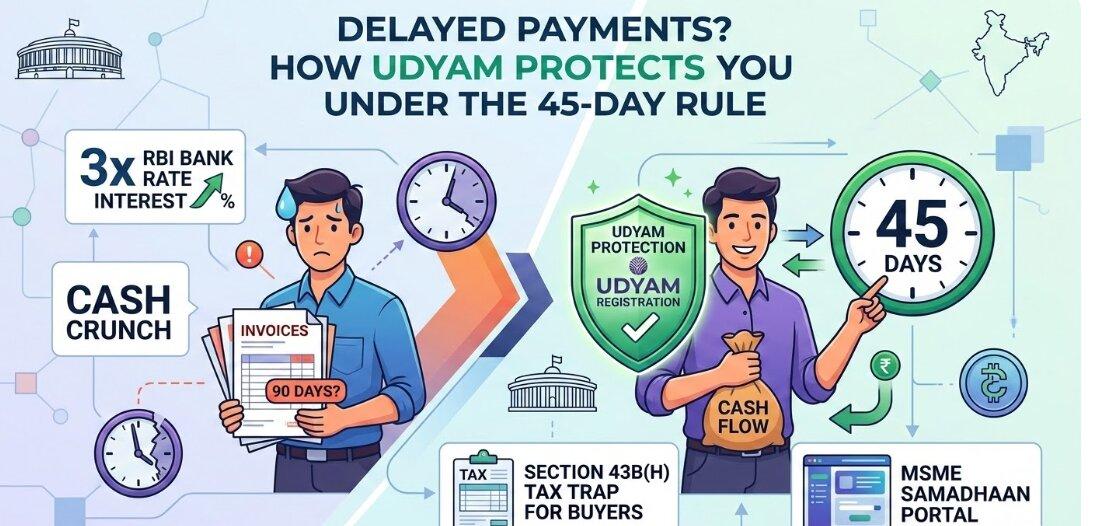
Small businesses in India often face problems regarding their cash flow due to delayed payment. Larger buyers often treat small vendors like interest free bank loans and stretch 30 days invoice to 90 day deadline. But if you have a udyam certificate then there are strict tax laws regarding payment Section 43B(h). You no longer have to beg buyers to clear their dues.
Here is how you can use the 45-day rule to maintain good cashflow:
The most effective debt-recovery tool in your arsenal isn't a lawyer—it’s the Income Tax Act. Under Section 43B(h), if a company buys from a registered Micro or Small enterprise and doesn't pay on time, they face a massive penalty:
The most effective tool to mention MSME cash flow is the Income Tax Act Under Section 43B(h), if a company buys any product/service from the Udyam registered MSME and doesn’t pay o time they have to face massive tax penalty:
Tax Disallowance: The buyer cannot claim that purchase as an expense for the financial year unless they pay you within the legal timeframe.
Higher Tax Bill: If they owe you ₹10 Lakh and miss the deadline, that ₹10 Lakh is added back to their taxable income. They end up paying tax on money they already "spent" on your goods!
2. Know Your Timelines (15 vs. 45 Days)
Your Udyam Registration activates two specific deadlines that every corporate accountant in India is now watching closely:
15 Days: This is the "Default Deadline." If you don't have a written agreement with your buyer, they must pay you within 15 days of receiving the goods or services.
45 Days: This is the "Absolute Maximum." Even if you sign a contract saying the buyer will pay in 90 days, the law overrides it. Any agreement beyond 45 days is legally void; the clock stops at 45.
3. The "3x Interest" Rule: Making Delays Expensive
If the tax penalty wasn't enough, the MSMED Act mandates that if a buyer delays payment beyond the 45-day window, they must pay you penal interest.
The Rate: Compounded monthly at 3 times the Bank Rate notified by the RBI.
Non-Deductible: The buyer cannot even claim this interest as a business expense. It is a pure loss for them.
|
Step |
Action |
Why it Matters |
|
01 |
Update Your Invoice |
Explicitly print your Udyam Registration Number and a note mentioning "Subject to MSMED Act 45-day payment rule" on every bill. |
|
02 |
Send a "Gentle" Reminder |
On day 30, send an email reminding them that to comply with Section 43B(h) and avoid tax disallowance, the payment must be cleared by Day 45. |
|
03 |
Use the MSME ODR Portal |
If they cross the limit, don't go to court. File a case on the MSME ODR (Online Dispute Resolution) portal (formerly Samadhaan). It’s 100% digital and faster than traditional litigation. |
The most important thing to remember is that to access these benefits you have to register your business with udyam and update udyam registration. You can not claim protection for an invoice raised before you got your registration. If you are operating without an Udyam Certificate in 2026, you are essentially leaving your cash flow to the mercy of your buyers.
Pro-Tip: In 2026, the MSME ODR portal has been upgraded with AI-powered tracking. Once you file a complaint, the buyer receives an automated legal notice, which usually clears "stuck" payments within 90–120 days without you ever stepping into a courtroom.
Ready to secure your payments?
Would you like me to help you draft a "Standard MSME Notice" template that you can attach to your invoices to ensure buyers take your deadlines seriously?