


Understanding the Science Behind Permanent Tattoo Removal
Understanding the Science Behind Permanent Tattoo Removal
The fascination with body art often evolves over time, leading many to seek a clean slate through medical intervention. For those looking into Permanent tattoo removal in Riyadh(إزالة الوشم الدائم في الرياض), the process is a marvel of physics and biology working in tandem to undo what was once considered "forever." To truly appreciate how a laser can vanish ink from beneath the skin, one must look past the surface and understand the microscopic battle between high-intensity light and the body’s resilient immune system. This guide breaks down the complex mechanics of how light energy is converted into a cleaning mechanism for the dermis.
The Biological Blueprint of a Tattoo
To understand removal, we must first understand why tattoos stay put. When a tattoo is created, a needle deposits large droplets of ink into the dermis, the stable layer of skin beneath the ever-changing epidermis. The body immediately recognizes this ink as a foreign invader. White blood cells, the body’s "janitors," rush to the site to engulf the ink particles and carry them away. However, the ink pigments used in professional tattooing are far too large for these tiny cells to swallow. The result is a biological stalemate: the white blood cells surround the ink but cannot move it, effectively "locking" the pigment in place for decades.
The Physics of Shattering: Selective Photothermolysis
The scientific breakthrough that allowed for non-invasive removal is a principle called Selective Photothermolysis. This process relies on three specific variables: wavelength, pulse duration, and energy intensity.
-
Wavelength: Light travels in different frequencies. To remove a tattoo, the laser must emit a wavelength that the ink color can absorb. For instance, black ink absorbs all wavelengths, while red ink requires a specific green-light frequency to be affected.
-
Pulse Duration: This is the "speed" of the laser. Modern lasers operate in nanoseconds (billionths of a second) or picoseconds (trillionths of a second).
-
Energy Intensity: The laser must be powerful enough to create a change but precise enough to spare the surrounding skin.
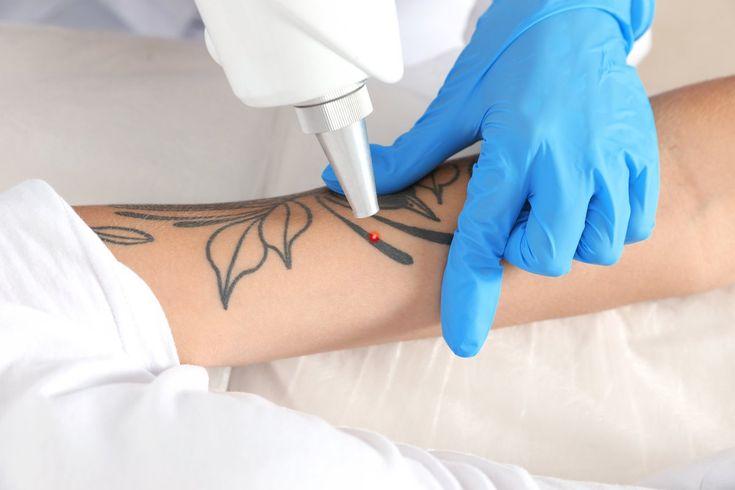
When the laser hits the ink, it performs a "photoacoustic" strike. The ink absorbs the energy so rapidly that it doesn't have time to heat up and burn the skin; instead, the internal pressure causes the ink particle to vibrate and shatter into microscopic "dust."
The Role of the Lymphatic System
Once the laser has successfully shattered the large ink droplets into tiny fragments, the biological stalemate is broken. The white blood cells that were previously too small to handle the ink can now easily engulf the microscopic debris.
These cells then enter the lymphatic system, a network of vessels that acts as the body's drainage system. The shattered ink is transported to the lymph nodes, filtered through the liver, and eventually excreted from the body as waste. This is why a tattoo does not disappear instantly the moment the laser touches it; rather, it fades gradually over 6 to 8 weeks as the body’s internal cleaning crew works behind the scenes.
Why Different Colors Require Different Science
The science of color plays a massive role in the success of Permanent tattoo removal in Riyadh. Because light is reflected or absorbed based on its color, a "one-size-fits-all" laser is scientifically impossible for multi-colored tattoos.
-
Dark Pigments: Black and dark blue are the easiest to treat because they are "ideal absorbers," soaking up almost any laser energy thrown at them.
-
Bright Pigments: Colors like lime green, yellow, and sky blue reflect much of the light energy. These require specialized, highly tuned lasers (like the 755nm Alexandrite) to create enough of a shockwave to break them down.
-
White Ink: Often contains titanium dioxide, which can sometimes "oxidize" or turn dark when hit by a laser, requiring a very specific scientific approach to clear.
Thermal Relaxation and Skin Safety
A critical concept in laser science is Thermal Relaxation Time (TRT). This is the amount of time it takes for a target to lose 50% of its heat. For the skin to remain unscarred, the laser pulse must be shorter than the TRT of the ink. Modern picosecond technology is revolutionary because its pulse is so incredibly fast that the ink shatters before the heat has a chance to transfer to the surrounding skin cells. This precision is what allows for the "permanent" nature of the removal without leaving a permanent scar in its place, provided the patient follows the necessary healing protocols.

 English
 Arabic
 French
 Spanish
 Portuguese
 Deutsch
 Dutch
Dutch
 Italiano
 Russian
 Romaian
 Portuguese (Brazil)
 Greek
Greek